

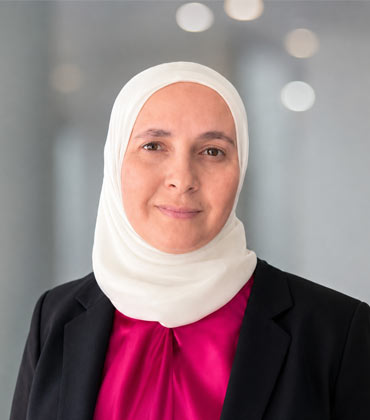
 Louna Al Hallak, PhD, Chief Academic Officer
My commitment to private higher education began with a belief that education should do more than present degrees—it should create opportunities, transform lives and respond meaningfully to the needs of society. Private institutions are uniquely positioned to serve diverse student populations, introduce innovative programs and adapt quickly to changes in the workforce.
Throughout my career, this purpose has evolved from supporting individual student achievement to helping build stronger and more sustainable educational institutions. My work in academic leadership, accreditation, program development, enrollment strategy and institutional planning has reinforced my belief that access must always be accompanied by quality. Today, I am especially committed to developing educational pathways that connect academic learning with career preparation, leadership development and lifelong learning.
Innovation Backed by Academic Rigor
Private higher education institutions face a combination of financial, demographic, technological and regulatory pressures. Students are increasingly questioning the cost and value of a degree, while institutions must respond to declining enrollment in some markets, growing competition, rapidly changing workforce expectations and the expansion of artificial intelligence.
The most effective response is not simply to offer more programs, but to create relevant and carefully designed learning experiences. Institutions must use evidence to evaluate their programs, invest in faculty development and strengthen academic and student-support systems.
Innovation and academic quality should never be treated as competing priorities. Institutions can adapt through flexible delivery models, industry partnerships, stackable credentials, responsible use of technology and career-connected curricula while maintaining clear learning outcomes, qualified faculty, meaningful assessment and strong academic oversight. Sustainable growth occurs when innovation is guided by mission and supported by evidence.
The Power of Collaborative Leadership
The leadership principle that has guided me most is to remain mission-centered while being willing to adapt. During periods of change, leaders often face pressure to make quick decisions. However, every decision should still be evaluated according to its effect on students, academic quality, institutional integrity and long-term sustainability.
I also believe strongly in collaborative leadership. Meaningful institutional change cannot be achieved by one individual. It requires open communication, shared responsibility and the involvement of faculty, staff, administrators, students and external partners. A leader must be willing to listen carefully, communicate honestly and make difficult decisions when necessary. Trust is built when people understand not only what is changing, but also why the change matters.
-
The future of higher education depends not on choosing between tradition and innovation, but on bringing them together with integrity, purpose and an unwavering commitment to student success.
The Future of Private Higher Education
Over the next decade, private higher education will become more flexible, personalized, technology-enabled and closely connected to workforce and societal needs. Traditional degree programs will remain important, but they will increasingly be complemented by short-term certificates, professional programs, stackable credentials and lifelong-learning opportunities.
Artificial intelligence will be one of the most influential forces shaping this transformation. It will affect curriculum development, teaching, assessment, student support, research and institutional operations. However, its value will depend on how responsibly it is used. Institutions must prepare students not only to use AI tools, but also to understand their ethical, professional and social implications.
Other important trends will include competency-based learning, stronger employer partnerships, international collaboration, data-informed decision-making and greater demand for programs in healthcare, technology, leadership, sustainability and public-sector innovation. The institutions that succeed will be those that can evolve without losing the human relationships, intellectual rigor and ethical foundations at the heart of education.
Building a Legacy that Outlasts Leadership
Begin by understanding that educational leadership is a responsibility, not simply a position. Be aware how institutional decisions affect the students’ lives. Listen to faculty and staff, study the evidence, understand the regulatory environment and remain willing to learn.
Leaders need to develop the courage to challenge outdated practices while respecting the history and mission of their institutions. To welcome innovation without adopting every new trend uncritically. And most importantly, to lead with integrity, consistency, humility and empathy.
A meaningful legacy in higher education is not defined only by the programs launched or the growth achieved. It is reflected in the people who were empowered, the opportunities that were created and the institutional culture that continues to serve students long after a leader’s tenure has ended.